Nigeria Assumes Leadership Role on IFAD Governing Council
Abuja, Nigeria, 12 February 2026
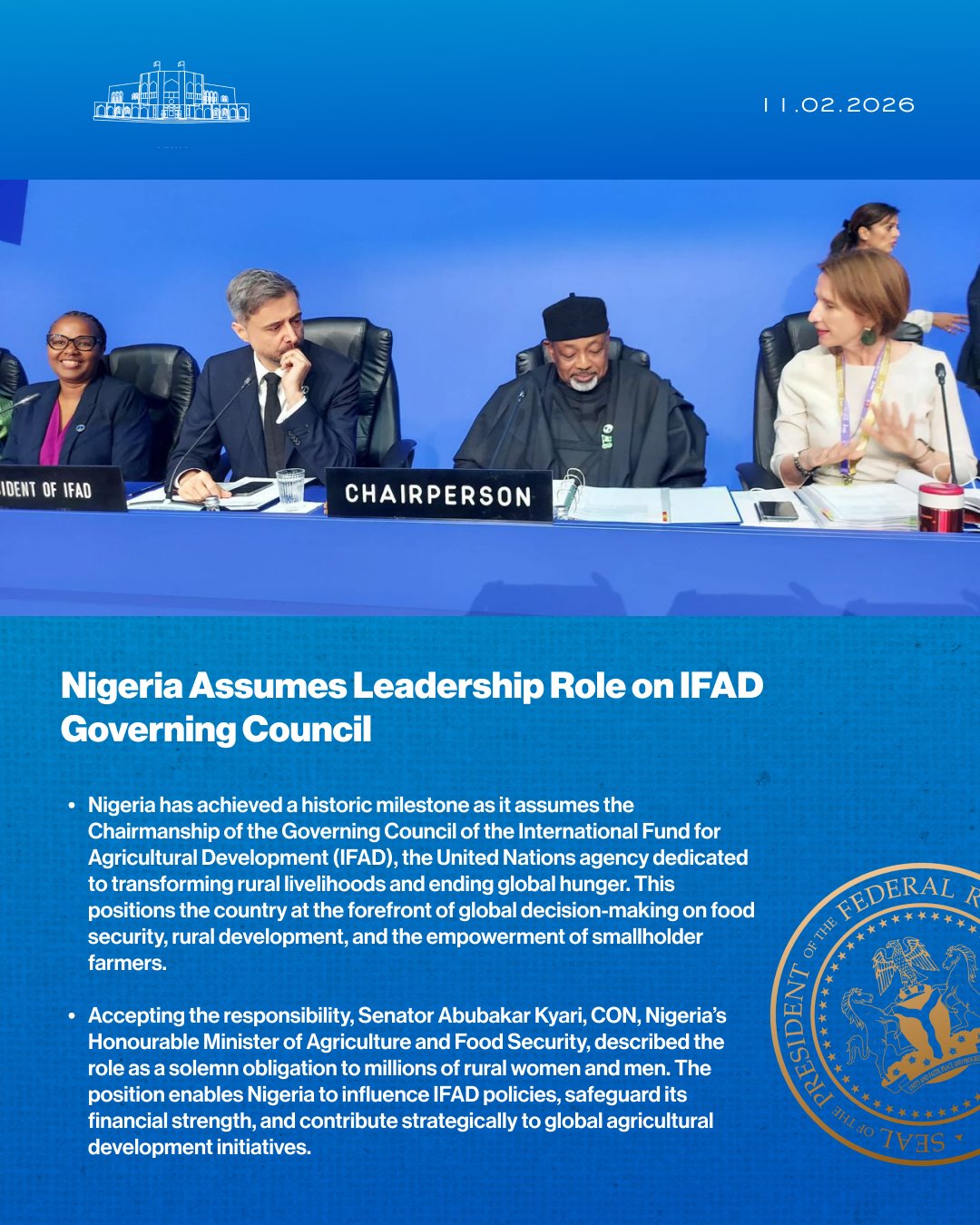
Nigeria has achieved a historic milestone as it assumes the Chairmanship of the Governing Council of the International Fund for Agricultural Development (IFAD), the United Nations agency dedicated to transforming rural livelihoods and ending global hunger. This development positions the country at the forefront of global decision-making on food security, rural development, and the empowerment of smallholder farmers.
The Governing Council is IFAD’s highest decision-making body, responsible for guiding the agency’s strategic direction, approving budgets, and shaping policies that impact millions of rural communities worldwide. Nigeria’s emergence as Chair underscores its growing influence in international agricultural diplomacy and its commitment to advancing sustainable food systems.
Accepting the responsibility, Senator Abubakar Kyari, CON, Nigeria’s Honourable Minister of Agriculture and Food Security, described the role as a solemn obligation to millions of rural women and men whose livelihoods depend on inclusive agricultural development.
“This is not merely a leadership position,” Senator Kyari stated. “It is a responsibility to champion the cause of smallholder farmers, rural youth, and women who form the backbone of our food systems.”
As Chair, Nigeria will play a central role in steering deliberations among IFAD’s member states, influencing policy frameworks, safeguarding the institution’s financial strength, and contributing strategically to global agricultural development initiatives. The role also provides a platform for Nigeria to advocate for innovative financing, climate-resilient farming practices, and stronger partnerships aimed at addressing food insecurity and poverty.
Nigeria’s leadership comes at a critical time when the world faces mounting challenges, including climate change, conflict, and economic instability, all of which threaten global food security. By assuming this position, Nigeria signals its readiness to collaborate with international partners to drive transformative solutions that enhance agricultural productivity, strengthen rural economies, and promote sustainable development.
The appointment reflects confidence in Nigeria’s experience and ongoing reforms in the agricultural sector, including efforts to boost local food production, improve access to finance for farmers, and modernize value chains.
As it takes the helm of the IFAD Governing Council, Nigeria is poised to amplify the voices of developing nations and help shape a more resilient and equitable global food system—one that leaves no rural community behind.