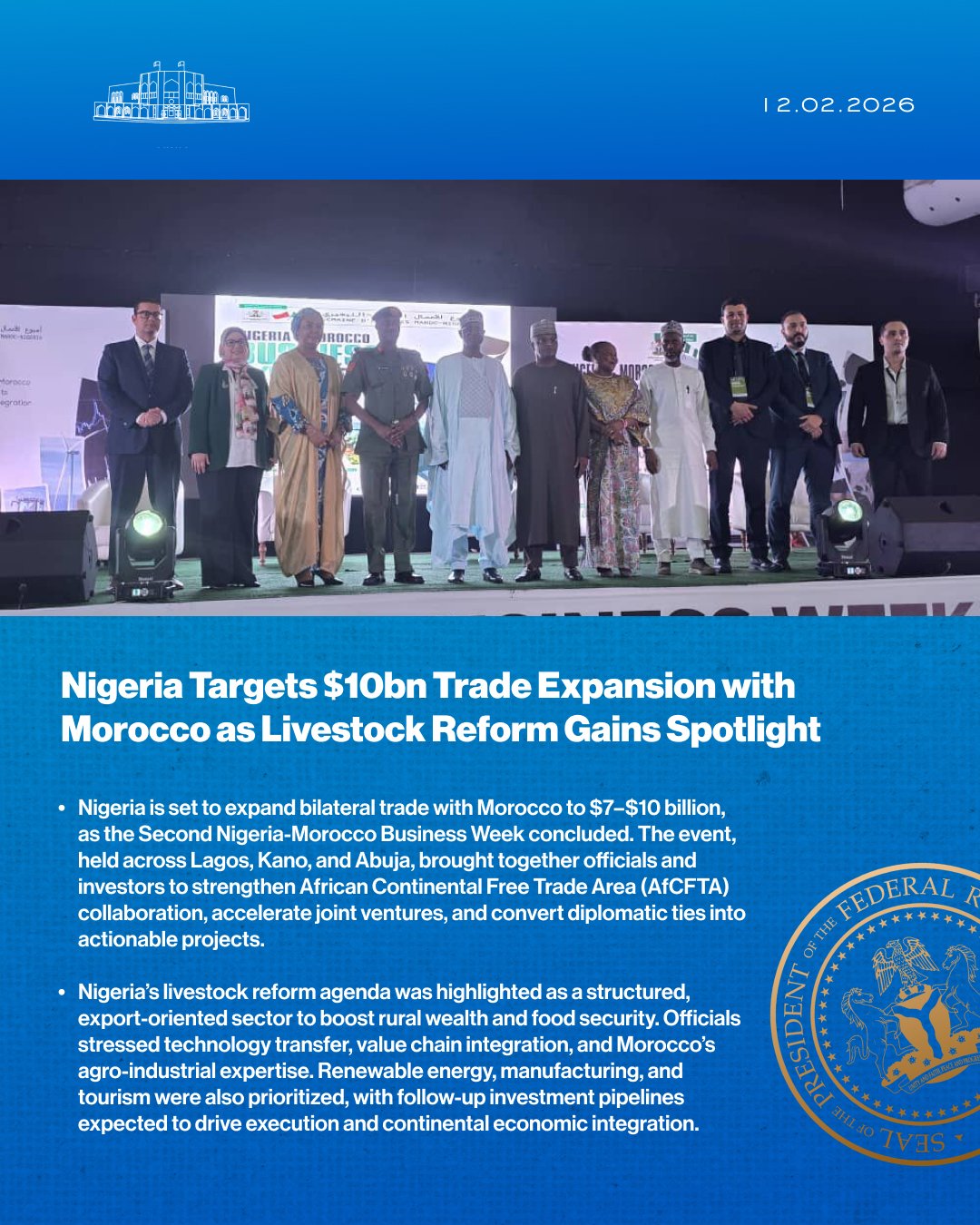
Nigeria Targets $10bn Trade Expansion with Morocco as Livestock Reform Gains Spotlight
Abuja, Nigeria | 12 February 2026
Nigeria has set an ambitious target to expand bilateral trade with the Kingdom of Morocco to between $7 billion and $10 billion, as the Second Nigeria-Morocco Business Week concluded with renewed commitments to deepen economic cooperation and fast-track joint investments.
The high-level business forum, held across Lagos, Kano, and Abuja, convened government officials, policymakers, and private sector leaders from both countries to strengthen collaboration under the African Continental Free Trade Area (AfCFTA). Participants focused on transforming longstanding diplomatic relations into concrete, bankable projects capable of driving sustainable growth.
Speaking at the closing session in Abuja, officials underscored the importance of structured engagement and measurable outcomes, noting that enhanced trade volumes would signal a new phase in Nigeria-Morocco economic relations. The event featured business-to-business meetings, sector-specific dialogues, and investment roundtables aimed at unlocking opportunities across key industries.
A major highlight of the discussions was Nigeria’s livestock reform agenda, which was presented as a strategic, export-oriented initiative designed to boost rural wealth creation, improve food security, and integrate pastoral communities into formal value chains. Stakeholders described the reform programme as a transformative effort to modernise livestock production through ranching systems, improved breeding, cold chain development, and agro-processing infrastructure.
Morocco’s agro-industrial expertise and experience in fertiliser production, irrigation systems, and agribusiness value chain integration were identified as critical areas for partnership. Both sides emphasised the need for technology transfer, skills development, and investment in processing facilities to enhance productivity and competitiveness.
Beyond agriculture, renewable energy emerged as a priority sector, with discussions centred on solar energy development, green hydrogen prospects, and grid expansion. Manufacturing and tourism were also spotlighted as high-potential areas, with investors exploring joint ventures that could leverage Nigeria’s large market and Morocco’s established export networks.
Officials expressed optimism that structured follow-up mechanisms and defined investment pipelines would ensure that agreements reached during the Business Week translate into tangible outcomes. The initiative is expected to further strengthen continental economic integration, align with AfCFTA objectives, and position both countries as key drivers of intra-African trade.
As momentum builds, stakeholders reaffirmed their commitment to sustained collaboration, policy alignment, and private sector engagement to achieve the targeted $10 billion trade milestone and unlock broader economic opportunities across Africa.