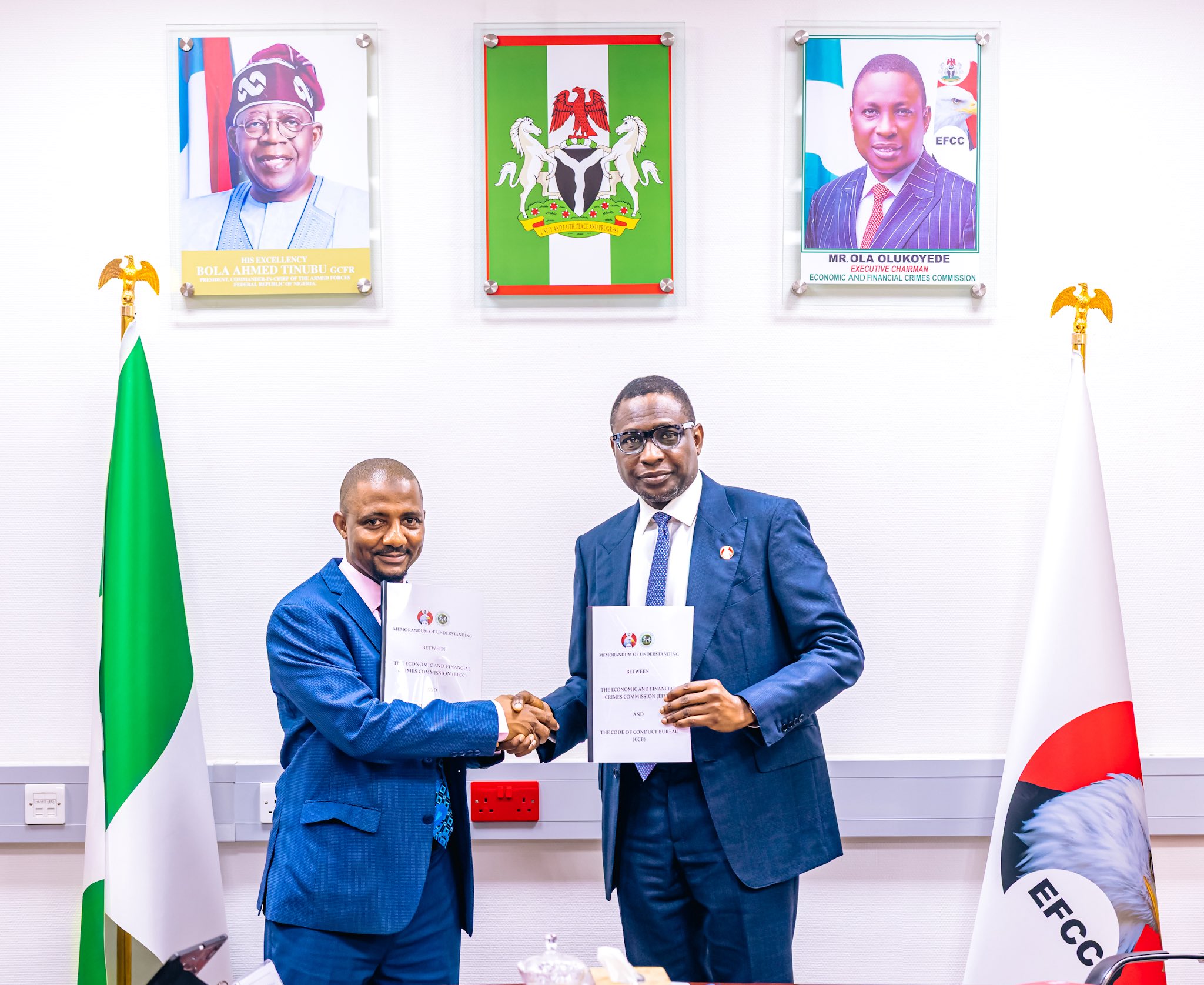
Olukoyede Reiterates Collaboration as Catalyst in Fight against Corruption
Abuja, February 18, 2026
The Executive Chairman of the (EFCC), Ola Olukoyede, has called for closer collaboration among anti-corruption agencies in Nigeria to achieve greater success in the fight against corruption.
Olukoyede made the call in Abuja on Wednesday, February 18, 2026, when the management team of the (CCB), led by its Chairman, Dr. Abdullahi Usman Bello, signed a Memorandum of Understanding (MoU) with the EFCC aimed at strengthening institutional cooperation.
Strength in Unity
In his remarks, Olukoyede stressed that all anti-corruption institutions are critical stakeholders in Nigeria’s development trajectory.
“All of us are key players in the anti-corruption fight. Everybody will agree with us that one of the major problems that is behind poverty, hunger, malnutrition, lack of infrastructure, generally lack of development in Nigeria is the issue of financial crimes and corruption. If we can make up our mind, work together as a team and ensure that we confront it frontally, we’ll probably take Nigeria out of this mess. We can complement each other.
“There’s no doubting the fact that we need to collaborate and synergize. We must not compete. We must collaborate. We must work with sincerity of purpose. That is what Mr. President has encouraged us to do by giving us this privilege to serve our nation.”
He expressed delight at the formal signing of the MoU, noting that both agencies had long enjoyed informal exchanges of ideas, intelligence, technical collaboration, and administrative support. He emphasized the need to operationalize the agreement to deepen and institutionalize cooperation.
Courage and Commitment in the Line of Duty
Encouraging the CCB Chairman, Olukoyede reminded him of the Bureau’s statutory powers, including the authority to freeze and confiscate assets as well as investigate and prosecute violations.
“You can’t be doing this kind of work and people will fall in love with you, unless you are not doing it well,” he said. “So be ready to be called names and abused. What is important is that we make an impact.”
He underscored that effective anti-corruption work demands courage, resilience, and an unwavering commitment to public interest.
A Milestone for CCB
Earlier in his remarks, Bello described the MoU as a significant milestone in the CCB’s anti-corruption drive, highlighting the depth of partnership and cooperation between the two institutions.
According to him, the agreement formalizes their shared resolve to strengthen integrity, transparency, and accountability in public life.
“The CCB enforces the highest ethical standards in Nigeria through asset declaration, verification, compliance, monitoring, while the EFCC leads with determination against economic and financial crimes,” Bello said. “We recognize that corruption cannot be defeated in silos. Definitely you cannot do it alone. Through this MoU, we commit to secure intelligence and information sharing.”
He further disclosed that the CCB maintains a comprehensive database of assets and liabilities declared by public servants across Nigeria.
“It is a very rich intelligence that the EFCC has been using and we will be able to share experience, also. That’s one of the key reasons why we have this MoU,” he noted.
Key Areas of Collaboration
Bello outlined several critical areas of collaboration under the MoU, including:
Joint investigations and operational support
Coordinated asset tracing and recovery
Capacity building and joint training programmes
Technological collaboration and improved case management
Unified public education and sensitization campaigns
“As we sign this MoU, let us signal a new era of united, effective action against corruption in Nigeria,” he said.
The agreement marks a renewed commitment by both the EFCC and the CCB to work in synergy, reinforcing the broader national objective of tackling corruption as a root cause of underdevelopment and socio-economic challenges in the country.